

Daily Quizzes
Mock Tests
No tests attempted yet.
Select Category
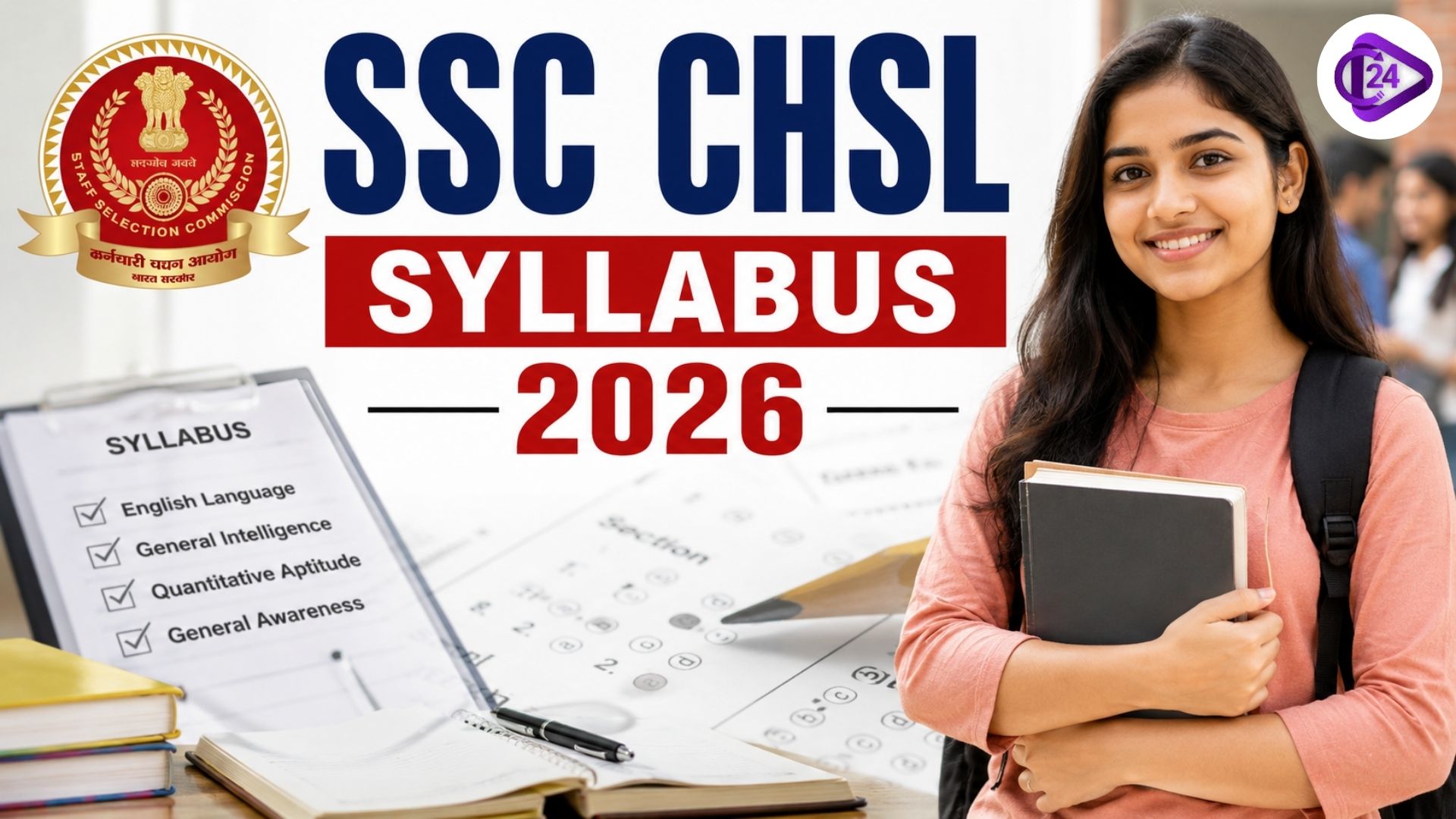
SSC CHSL Syllabus 2026: Tier 1 & Tier 2 Subject-Wise Syllabus, Topics & Exam Pattern
SSC CHSL Syllabus 2026 covers the complete subject-wise topics for Tier 1 and Tier 2, including General Intelligence & Reasoning, Quantitative Aptitude, English Language, General Awareness, Mathematical Abilities, Computer Knowledge, and Skill/Typing Test. Check the detailed SSC CHSL syllabus, important topics, high-weightage areas, and Tier-wise subject coverage to plan your preparation effectively.


Get in Touch with Class24 for All Your Needs!
SSC CHSL Syllabus 2026 covers the complete subject-wise topics prescribed by the Staff Selection Commission for the Combined Higher Secondary (10+2) Level Examination. The examination includes English Language, General Intelligence, Quantitative Aptitude, General Awareness, Mathematical Abilities, Reasoning, Computer Knowledge and a Skill Test or Typing Test, depending on the post.
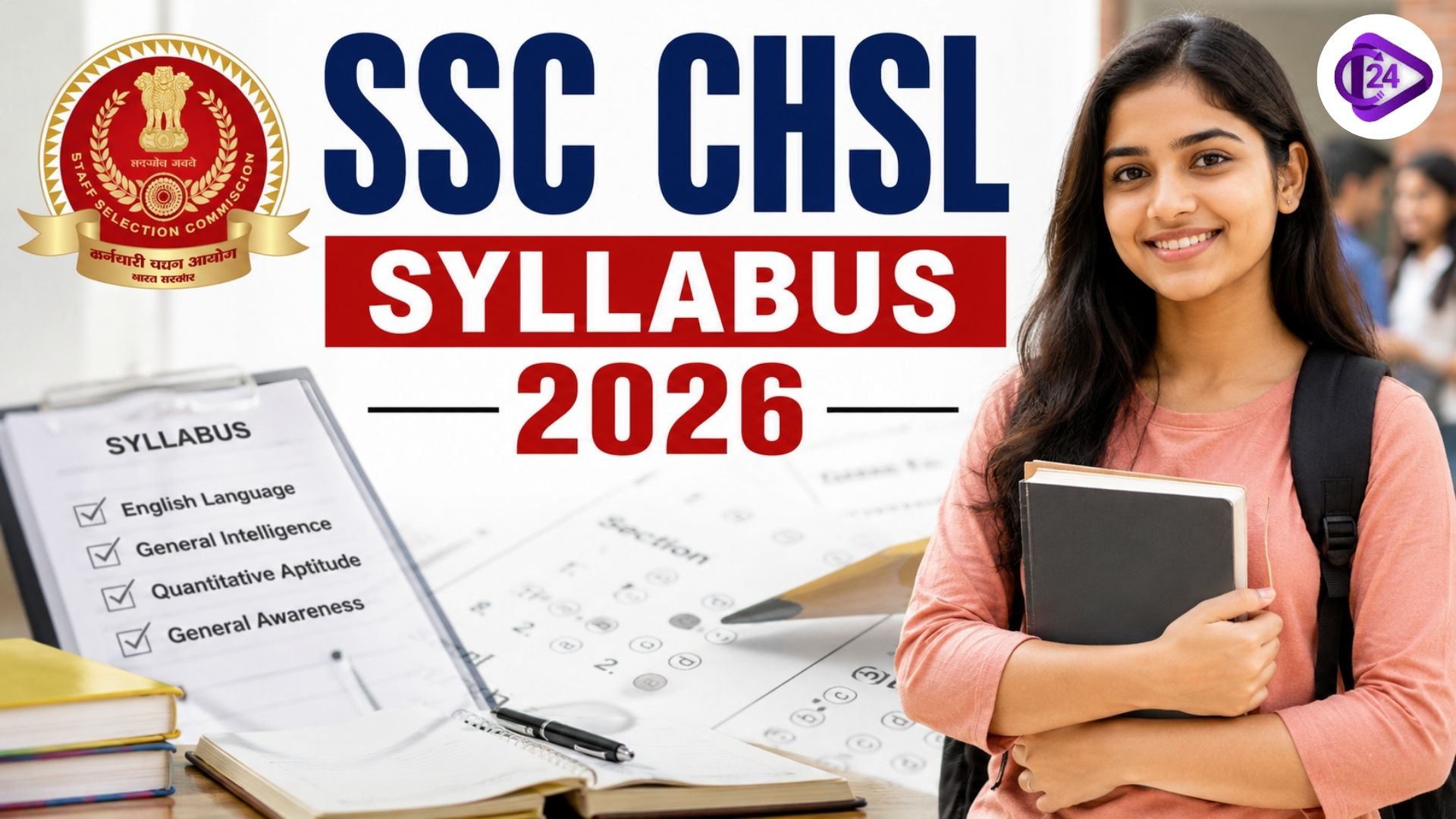
Candidates preparing for SSC CHSL 2026 should understand the syllabus of both Tier 1 and Tier 2 before starting their preparation. Tier 1 is the first stage of the selection process, while Tier 2 includes the main merit-based sections along with qualifying Computer Knowledge and Skill/Typing Tests.
In this guide, you can check the complete SSC CHSL Tier 1 syllabus, Tier 2 syllabus, subject-wise topics, official Computer Knowledge syllabus, DEO Skill Test requirements, LDC/JSA typing speed and preparation guidance. The topic coverage below follows the SSC CHSL 2026 official notification.
SSC CHSL Syllabus 2026: Overview
Before studying individual subjects, candidates should understand the major sections included in both stages of the SSC CHSL examination.
| Particulars | Details |
|---|---|
| Exam Name | Combined Higher Secondary (10+2) Level Examination |
| Conducting Authority | Staff Selection Commission (SSC) |
| Examination Year | 2026 |
| Selection Stages | Tier 1 and Tier 2 |
| Tier 1 Subjects | English Language, General Intelligence, Quantitative Aptitude and General Awareness |
| Tier 2 Subjects | Mathematical Abilities, Reasoning and General Intelligence, English Language and Comprehension, General Awareness and Computer Knowledge |
| Skill Test | DEO Skill Test or LDC/JSA Typing Test, as applicable |
| Negative Marking | 0.50 marks in Tier 1 and 1 mark in each wrong answer in Tier 2 Sections I, II and III |
| Official Website | ssc.gov.in |
SSC CHSL Syllabus 2026 Official PDF Download
Candidates should refer to the official SSC notification for the complete examination scheme, indicative syllabus, skill test requirements and selection process.
Official Notification: Download SSC CHSL 2026 Notification PDF
The subject-wise topics provided in this article are organised according to the indicative syllabus in the official notification. Candidates should also check the SSC website for any subsequent corrigendum or examination-related update.
Table of Contents
Click Here to Open / Close Table of Contents
- SSC CHSL Syllabus 2026 Overview
- Official Syllabus PDF Download
- SSC CHSL Tier 1 Syllabus 2026
- General Intelligence and Reasoning
- Quantitative Aptitude
- English Language
- General Awareness
- SSC CHSL Tier 2 Syllabus 2026
- Mathematical Abilities
- Reasoning and General Intelligence
- English Language and Comprehension
- General Awareness
- Computer Knowledge Syllabus
- SSC CHSL Skill Test and Typing Test
- Important Topics for Preparation
- Subject-Wise Preparation Strategy
- Common Preparation Mistakes
- Important Links
- Frequently Asked Questions
SSC CHSL Tier 1 Syllabus 2026
The SSC CHSL Tier 1 examination consists of four subjects: English Language, General Intelligence, Quantitative Aptitude and General Awareness. Each subject contains 25 questions carrying 50 marks.
The Tier 1 examination has a total of 100 questions for 200 marks. Candidates receive 15 minutes for each subject, with a total examination duration of 60 minutes for candidates not eligible for compensatory time.
SSC CHSL Tier 1 Subject-Wise Syllabus
| Subject | Questions | Marks | Time |
|---|---|---|---|
| English Language | 25 | 50 | 15 Minutes |
| General Intelligence | 25 | 50 | 15 Minutes |
| Quantitative Aptitude | 25 | 50 | 15 Minutes |
| General Awareness | 25 | 50 | 15 Minutes |
| Total | 100 | 200 | 60 Minutes |
Negative Marking: There is a deduction of 0.50 marks for each incorrect answer in Tier 1. Candidates should manage their time carefully because each subject has a separate sectional timer.
1. General Intelligence and Reasoning Syllabus
The General Intelligence section evaluates logical thinking, analytical ability, pattern recognition and problem-solving skills. Questions may be based on both verbal and non-verbal reasoning.
| Topic | Detailed Topics |
|---|---|
| Analogy | Semantic Analogy, Symbolic Analogy, Number Analogy and Figural Analogy |
| Classification | Semantic Classification, Symbolic Classification and Figural Classification |
| Series | Number Series, Semantic Series and Figural Series |
| Spatial Ability | Space Orientation and Trends |
| Visual Reasoning | Embedded Figures, Punched Hole, Pattern Folding and Unfolding |
| Logical Reasoning | Drawing Inferences, Critical Thinking and Problem Solving |
| Other Topics | Word Building, Emotional Intelligence, Social Intelligence, Coding and Decoding, Numerical Operations and Symbolic Operations |
| Venn Diagrams | Questions based on classification and relationships between different groups |
Preparation Note: Practise different types of analogy, series, coding-decoding and non-verbal reasoning questions. Regular timed practice can help improve both speed and accuracy.
2. Quantitative Aptitude Syllabus
Quantitative Aptitude tests numerical ability and mathematical understanding. The syllabus includes arithmetic, algebra, geometry, mensuration, trigonometry and statistical charts.
| Topic | Detailed Topics |
|---|---|
| Number System | Whole Numbers, Decimal Numbers, Fractions and Relationship Between Numbers |
| Arithmetic | Percentage, Ratio and Proportion, Square Roots and Averages |
| Profit and Loss | Profit and Loss, Discount and Partnership Business |
| Interest | Simple Interest and Compound Interest |
| Mixture | Mixture and Alligation |
| Time and Work | Time and Work Problems |
| Time and Distance | Speed, Time and Distance Problems |
| Algebra | Basic Algebraic Identities, Elementary Surds and Graphs of Linear Equations |
| Geometry | Triangles, Centres of Triangles, Congruence and Similarity, Circles, Chords, Tangents and Angles Subtended by Chords |
| Mensuration | Triangle, Quadrilaterals, Regular Polygons, Circle, Right Prism, Cone, Cylinder, Sphere, Hemisphere and Regular Right Pyramid |
| Trigonometry | Trigonometric Ratios, Complementary Angles, Heights and Distances and Standard Identities |
| Statistical Charts | Histogram, Frequency Polygon, Bar Diagram and Pie Chart |
3. English Language Syllabus
The English Language section checks vocabulary, grammar, sentence structure and reading comprehension. Candidates should work on both grammar rules and regular reading practice.
| Topic | Detailed Topics |
|---|---|
| Grammar | Spot the Error, Fill in the Blanks and Improvement of Sentences |
| Vocabulary | Synonyms, Homonyms, Antonyms, Spellings and One Word Substitution |
| Idioms | Idioms and Phrases |
| Voice | Active Voice and Passive Voice |
| Narration | Direct and Indirect Speech |
| Sentence Arrangement | Shuffling of Sentence Parts and Shuffling of Sentences in a Passage |
| Comprehension | Cloze Passage and Comprehension Passage |
4. General Awareness Syllabus
The General Awareness section evaluates knowledge of current events, everyday observations, Indian history, culture, geography, economic developments, general policy and scientific research.
| Topic | Detailed Coverage |
|---|---|
| Current Affairs | National and International Events and Important Current Developments |
| History | Indian History and Important Historical Events |
| Culture | Indian Culture, Traditions and Heritage |
| Geography | Indian Geography and World Geography |
| Economy | Indian Economic Scene and Basic Economic Awareness |
| General Policy | Indian Constitution, Polity and Government-related Topics |
| General Science | Scientific Research and Everyday Scientific Observations |
Preparation Note: The notification does not prescribe a fixed six-month current affairs limit. Candidates can use recent current affairs as a preparation strategy, but should not treat any particular time window as an official syllabus rule.
SSC CHSL Tier 2 Syllabus 2026
Tier 2 is the main stage for determining the final merit list. It includes Mathematical Abilities, Reasoning and General Intelligence, English Language and Comprehension, General Awareness, Computer Knowledge and a Skill/Typing Test.
Tier 2 is conducted in two sessions on the same day. Session I includes Sections I, II and III, while Session II includes the Skill Test or Typing Test in Section IV.
SSC CHSL Tier 2 Sections and Marks
| Section | Subject | Questions | Marks | Time |
|---|---|---|---|---|
| Section I – Module I | Mathematical Abilities | 30 | 90 | 30 Minutes |
| Section I – Module II | Reasoning and General Intelligence | 30 | 90 | 30 Minutes |
| Section II – Module I | English Language and Comprehension | 40 | 120 | 40 Minutes |
| Section II – Module II | General Awareness | 20 | 60 | 20 Minutes |
| Section III | Computer Knowledge Test | 15 | 45 | 15 Minutes |
| Section IV | Skill Test / Typing Test | As applicable | Qualifying | As applicable |
Important: Section I and Section II carry a combined 360 marks. Section III and Section IV are qualifying in nature. Candidates must qualify the applicable Tier 2 sections according to the SSC rules.
1. Mathematical Abilities Syllabus (Tier 2)
Mathematical Abilities includes the major arithmetic and advanced mathematics topics prescribed by SSC. It also covers statistics and basic probability.
| Topic | Detailed Topics |
|---|---|
| Number Systems | Whole Numbers, Decimal Numbers, Fractions and Relationship Between Numbers |
| Arithmetic Operations | Percentage, Ratio and Proportion, Square Roots and Averages |
| Interest and Business Mathematics | Simple Interest, Compound Interest, Profit and Loss, Discount and Partnership Business |
| Mixture and Work | Mixture and Alligation, Time and Work, Time and Distance |
| Algebra | Basic Algebraic Identities, Elementary Surds and Graphs of Linear Equations |
| Geometry | Triangles, Congruence, Similarity, Circles, Chords, Tangents and Related Geometrical Concepts |
| Mensuration | Triangle, Quadrilaterals, Regular Polygons, Circle, Right Prism, Cone, Cylinder, Sphere, Hemisphere and Pyramid |
| Trigonometry | Trigonometric Ratios, Complementary Angles, Heights and Distances and Standard Identities |
| Statistics | Tables, Graphs, Histogram, Frequency Polygon, Bar Diagram, Pie Chart, Mean, Median, Mode and Standard Deviation |
| Probability | Calculation of Simple Probabilities |
2. Reasoning and General Intelligence Syllabus (Tier 2)
The Tier 2 Reasoning module tests verbal and non-verbal reasoning, analytical thinking, logical interpretation and numerical operations.
| Topic | Detailed Topics |
|---|---|
| Analogy | Semantic Analogy, Symbolic/Number Analogy and Figural Analogy |
| Classification | Semantic, Symbolic/Number and Figural Classification |
| Series | Semantic Series, Number Series and Figural Series |
| Spatial Reasoning | Space Orientation and Trends |
| Visual Reasoning | Embedded Figures, Punched Hole, Pattern Folding and Unfolding, Figural Pattern Completion |
| Logical Skills | Drawing Inferences, Critical Thinking and Problem Solving |
| Other Topics | Emotional Intelligence, Social Intelligence, Word Building, Coding and Decoding, Numerical Operations and Symbolic Operations |
| Venn Diagrams | Questions based on classification and logical relationships |
3. English Language and Comprehension Syllabus (Tier 2)
The Tier 2 English section tests vocabulary, grammar, sentence structure and reading comprehension. The official syllabus also describes comprehension passages based on a book or story and current affairs editorials or reports.
| Topic | Detailed Topics |
|---|---|
| Vocabulary | Synonyms, Antonyms, Homonyms, Correct Word Usage and Spellings |
| Grammar | Spot the Error, Fill in the Blanks and Improvement of Sentences |
| Idioms | Idioms and Phrases |
| Word Usage | One Word Substitution |
| Voice and Narration | Active/Passive Voice and Direct/Indirect Speech |
| Sentence Arrangement | Shuffling of Sentence Parts and Sentences in a Passage |
| Reading Comprehension | Cloze Passage and Comprehension Passages based on stories, books, editorials or reports |
4. General Awareness Syllabus (Tier 2)
General Awareness in Tier 2 covers knowledge of the environment, current events, everyday scientific observations and important subjects related to India and neighbouring countries.
| Topic | Detailed Coverage |
|---|---|
| History | Important Indian Historical Events and Developments |
| Culture | Indian Culture, Heritage and Traditions |
| Geography | India and Neighbouring Countries, Physical and General Geography |
| Economic Scene | Basic Economic Awareness and Important Developments |
| General Policy | Indian Polity and Government-related Awareness |
| Science | Everyday Scientific Observations, Scientific Knowledge and Research |
| Current Events | Important National and International Events |
5. Computer Knowledge and Proficiency Syllabus
Computer Knowledge is a mandatory qualifying section of Tier 2. Candidates should prepare basic computer concepts, operating systems, office applications, internet usage, networking and cyber security.
| Topic | Detailed Topics |
|---|---|
| Computer Basics | Organisation of a Computer, Central Processing Unit (CPU), Input and Output Devices |
| Memory | Computer Memory, Memory Organisation and Backup Devices |
| Ports and Windows | Computer Ports, Windows Explorer and Keyboard Shortcuts |
| Software | Windows Operating System and Basics of Microsoft Word, Excel and PowerPoint |
| Internet | Web Browsing, Searching, Downloading and Uploading |
| Managing an Email Account and Email-related Operations | |
| Digital Services | Basic Knowledge of E-Banking |
| Networking | Networking Devices and Protocols |
| Cyber Security | Network and Information Security Threats, Hacking, Viruses, Worms, Trojans and Preventive Measures |
Important: The Computer Knowledge Test contains 15 questions carrying 45 marks and has a duration of 15 minutes. It is mandatory but qualifying in nature.
SSC CHSL Skill Test and Typing Test 2026
Tier 2 includes a Skill Test or Typing Test according to the post applied for. Candidates should prepare for the relevant test instead of focusing only on objective questions.
DEO Skill Test
The Data Entry Operator Skill Test checks the candidate's data entry speed and accuracy. The applicable speed requirement depends on the department or ministry specified in the notification.
| Post / Category | Required Speed | Duration |
|---|---|---|
| DEO / DEO Grade A in the specified Department/Ministry under Para 8.1 | 15,000 Key Depressions per Hour | 15 Minutes |
| DEO / DEO Grade A in other applicable departments | 8,000 Key Depressions per Hour | 15 Minutes |
The Skill Test is mandatory for candidates applying for DEO posts. The test is qualifying in nature, and candidates must meet the prescribed evaluation requirements.
LDC/JSA Typing Test
Candidates applying for LDC/JSA posts have to qualify the Typing Test in either English or Hindi. The medium selected in the application form is treated as final.
| Typing Medium | Required Typing Speed | Duration |
|---|---|---|
| English | 35 Words Per Minute (WPM) | 10 Minutes |
| Hindi | 30 Words Per Minute (WPM) | 10 Minutes |
Hindi Typing: Candidates choosing Hindi typing must use the Mangal Font only, as specified in the official notification.
The Typing Test is qualifying in nature. Candidates should practise typing regularly with a focus on both speed and accuracy.
SSC CHSL 2026: Important Topics to Focus On
The official notification provides the indicative syllabus but does not publish a guaranteed topic-wise weightage. The following table is a preparation-priority guide based on the nature of the syllabus and commonly practised question types. It should not be treated as an official prediction of the examination.
| Subject | Suggested Preparation Priorities |
|---|---|
| Reasoning | Analogy, Classification, Series, Coding-Decoding, Venn Diagrams and Non-Verbal Reasoning |
| Mathematics | Percentage, Ratio, Average, Profit and Loss, Interest, Time and Work, Geometry and Mensuration |
| English | Reading Comprehension, Spot the Error, Vocabulary, Idioms, One Word Substitution and Cloze Test |
| General Awareness | History, Geography, Polity, Economy, General Science and Current Affairs |
| Computer Knowledge | Computer Fundamentals, MS Office, Internet, Networking and Cyber Security |
Subject-Wise Preparation Strategy for SSC CHSL 2026
A well-planned preparation strategy helps candidates cover the complete syllabus without leaving important topics for the final stage.
1. Preparation Strategy for Mathematics
- Start with number systems and fundamental arithmetic operations.
- Understand percentage, ratio, average, profit and loss and interest concepts.
- Practise geometry, mensuration and trigonometry regularly.
- Revise formulas and solve previous-year questions.
- Attempt timed sectional tests to improve calculation speed.
2. Preparation Strategy for Reasoning
- Practise analogy, classification and series questions daily.
- Learn different coding-decoding patterns.
- Practise non-verbal reasoning and figure-based questions.
- Focus on accuracy before increasing speed.
- Analyse incorrect answers after every mock test.
3. Preparation Strategy for English
- Study grammar rules and apply them through practice questions.
- Improve vocabulary through regular revision.
- Practise comprehension passages and cloze tests.
- Revise synonyms, antonyms, idioms and one-word substitutions.
- Practise sentence improvement and error detection questions.
4. Preparation Strategy for General Awareness
- Cover Indian History, Geography, Polity and Economy.
- Study basic Physics, Chemistry and Biology concepts.
- Revise important national and international current affairs.
- Prepare short notes for important facts and events.
- Use regular quizzes and mock tests for revision.
5. Preparation Strategy for Computer Knowledge
- Understand basic computer hardware and software.
- Practise MS Word, Excel and PowerPoint fundamentals.
- Learn internet, email and networking basics.
- Study common cyber security threats and preventive measures.
- Practise objective questions based on the official syllabus.
6. Preparation Strategy for Typing and Skill Test
- Start typing practice well before the examination.
- Practise with the same language medium selected in the application form.
- Focus on typing accuracy along with speed.
- DEO candidates should practise data entry using timed passages.
- Hindi typing candidates should practise using Mangal Font.
Common Mistakes to Avoid While Preparing for SSC CHSL
- Ignoring Tier 2: Do not focus only on Tier 1 because the final merit list is based on Tier 2 performance.
- Skipping Computer Knowledge: The Computer Knowledge Test is mandatory and qualifying in nature.
- Ignoring Typing Practice: Candidates targeting LDC/JSA should practise typing regularly.
- Studying Without Revision: Revise previously studied topics to improve retention.
- Ignoring Previous-Year Questions: Practise previous-year questions to understand the nature and level of questions.
- Blind Guessing: Negative marking makes accuracy an important part of exam strategy.
- Following Unverified Weightage: Do not assume that a particular topic will definitely carry a fixed number of questions.
Conclusion
The SSC CHSL Syllabus 2026 covers a wide range of subjects, including English Language, General Intelligence, Quantitative Aptitude, General Awareness, Mathematical Abilities, Computer Knowledge and the applicable Skill or Typing Test. Candidates should understand the complete Tier 1 and Tier 2 syllabus before starting their preparation.
For better preparation, focus on understanding basic concepts, practising previous-year questions, revising important topics and attempting regular mock tests. Candidates preparing for LDC/JSA should also practise typing, while DEO aspirants should work on improving their data entry speed and accuracy.
Frequently Asked Questions (FAQs) on SSC CHSL Syllabus 2026
The SSC CHSL Syllabus 2026 includes English Language, General Intelligence, Quantitative Aptitude and General Awareness in Tier 1. Tier 2 includes Mathematical Abilities, Reasoning, English, General Awareness, Computer Knowledge and a Skill/Typing Test.
SSC CHSL Tier 1 has four subjects: English Language, General Intelligence, Quantitative Aptitude and General Awareness. Each subject contains 25 questions carrying 50 marks.
The SSC CHSL Tier 1 examination carries 200 marks. It consists of 100 objective questions, with each question carrying 2 marks.
Tier 2 includes Mathematical Abilities, Reasoning and General Intelligence, English Language and Comprehension, General Awareness, Computer Knowledge and the applicable Skill/Typing Test.
Yes. The Computer Knowledge Test is mandatory in Tier 2. It is qualifying in nature, so candidates must meet the prescribed qualifying standard.
The required typing speed is 35 words per minute for English and 30 words per minute for Hindi. The Typing Test duration is 10 minutes, subject to applicable compensatory-time provisions.
The required speed is 15,000 key depressions per hour for DEO posts in the specified departments or ministries under the notification. For other applicable DEO posts, the requirement is 8,000 key depressions per hour.
Yes. The Skill Test or Typing Test is qualifying in nature. Candidates must meet the prescribed standard for the relevant post.
Yes. Tier 1 has a negative marking of 0.50 marks for each incorrect answer. In Tier 2, 1 mark is deducted for each incorrect answer in Sections I, II and III.
The Computer Knowledge syllabus includes computer basics, CPU, input/output devices, memory, backup devices, Windows, MS Word, Excel, PowerPoint, internet, email, e-banking, networking and cyber security.
Recent Quizzes

Our Courses

Post a Comment
Your email address will not be published. Required fields are marked *